
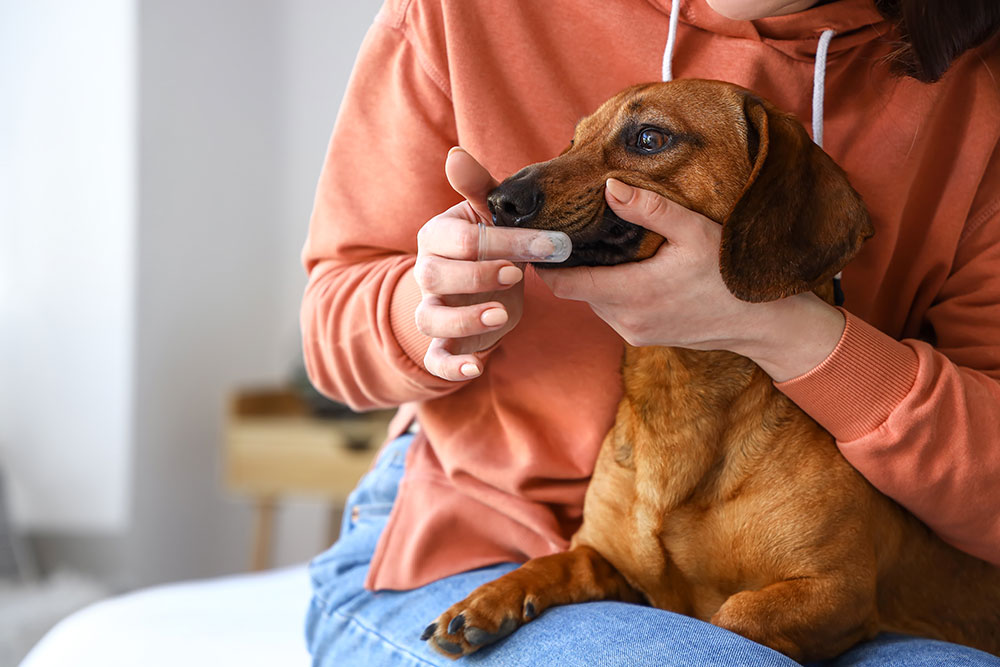
If brushing your pet’s teeth sounds simple in theory but turns into a wrestling match in practice, you are not alone. Many pets react to a toothbrush like it is a suspicious object that must be avoided at all costs. Some clamp their jaws shut. Others perform impressive disappearing acts the moment the toothpaste appears. While at-home dental care can feel challenging at first, a step-by-step approach can make the process far more manageable for both pets and their humans. And when brushing just is not going to happen, there are other products that can make a real difference without the need to fight your pet.
At Animal Medical Hospital of Naples, we believe that creating personalized plans is central to truly compassionate care, and our veterinary dental services include thorough at-home guidance alongside professional cleanings. Contact us to schedule a dental evaluation and walk away with a home care plan tailored to your specific pet’s needs and temperament.
Why Does Dental Home Care Actually Matter?
Plaque is a soft bacterial film that coats teeth constantly. It forms within hours of a meal and, if not disrupted by mechanical cleaning or enzymatic action, mineralizes into tartar within days. Tartar is porous and harbors bacteria at the gumline, where the infection causes periodontal disease: progressive destruction of the gum tissue, ligaments, and bone that support teeth. Studies consistently show that most dogs and cats have some degree of periodontal disease by age three.
The consequences extend beyond the mouth. Chronic oral infection introduces bacteria into the bloodstream that can damage the heart valves, kidneys, and liver over time. Catching and interrupting disease progression early, through both home care and professional dental cleanings under anesthesia, reduces that systemic burden meaningfully.
Home care and professional cleanings serve different functions and neither replaces the other. Home care prevents new plaque from establishing and slows tartar formation between appointments. Professional cleanings remove hardened tartar, address disease below the gumline, and provide the dental radiographs that reveal what no surface examination can see.
Why the VOHC Seal Matters
The first step to making a good dental health plan is picking the right products. The Veterinary Oral Health Council (VOHC) is an independent organization that evaluates dental products for pets and awards its seal of acceptance to products that demonstrate measurable effectiveness in reducing plaque or tartar through clinical trial data. This is not a self-certification; manufacturers submit evidence, and it is reviewed against defined standards before a seal is granted.
Looking for VOHC-accepted products when shopping for dental chews, water additives, diets, wipes, and other oral care items provides reliable assurance that a product has been tested and shown to work. Not every effective product carries the seal, and not every product on the shelf claiming dental benefits has earned it. When in doubt, our team can advise on which products are worth including in a home care routine.
Brushing: Why It’s Still the Best Option
The Mechanical Advantage
Brushing works because it physically disrupts the bacterial biofilm before it can mineralize. No rinse, additive, or chew does this as completely or as reliably. Daily brushing offers the strongest protection, and every-other-day brushing still provides meaningful benefit. The key is consistency rather than perfection: an imperfect brushing session repeated regularly outperforms an occasional perfect one.
Introducing Brushing to a Pet Who Has Never Done It
The introduction process matters more than most owners expect. Moving too quickly creates negative associations that make the whole routine harder to maintain. Cooperative care techniques break the process into small, rewarded steps that build tolerance gradually over days to weeks.
A practical starting sequence:
- Touch the muzzle and around the lips; reward and stop
- Lift the lip briefly to touch the teeth; reward and stop
- Run a finger along the outer gum surface; reward and stop
- Place a small amount of pet toothpaste on a finger and let the pet taste it; reward
- Apply paste to a finger brush or soft toothbrush and brush the outer surfaces of the front teeth
- Gradually extend coverage toward the back teeth over multiple sessions
Never use human toothpaste. Fluoride is toxic to pets, and foaming agents cause nausea. Pet toothpastes are designed to be swallowed and come in flavors dogs and cats accept, which matters because pets cannot rinse and spit. C.E.T. Enzymatic Toothpaste is a veterinary-formulated option with an enzymatic component that provides antimicrobial benefit in addition to the mechanical cleaning, and comes in a variety of pet-friendly flavors.
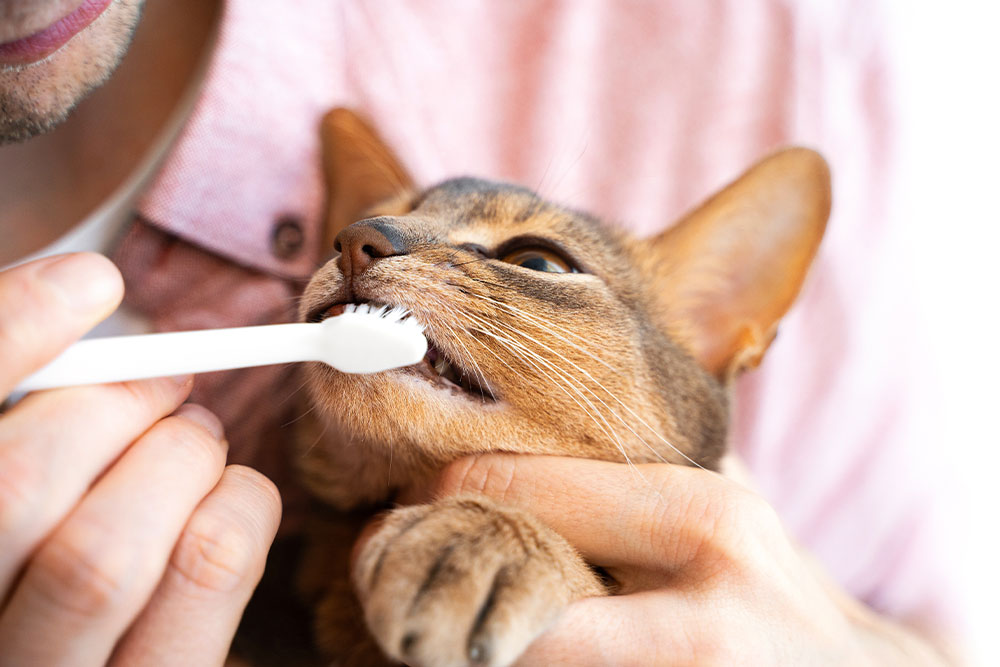
Brushing dog teeth is similar to humans; position the brush at a 45-degree angle to the tooth surface, angling the bristles toward the gumline, and using small circular or elliptical strokes. The outer surfaces of the upper teeth accumulate the most tartar and should receive the most attention. For brushing cat teeth, a smaller brush and gentler restraint are required. Most cats tolerate brief sessions on the outer tooth surfaces when introduced gradually with positive reinforcement and when the owner works with the cat’s natural head position rather than forcing it.
The C.E.T. Fingerbrush with Toothpaste Sample is a good starting point for pets new to brushing, as the finger brush allows more tactile control than a handled toothbrush. Check out the toothpaste and toothbrush selection in our pharmacy for different sizes and preferences.
Our team can demonstrate proper brushing technique during a dental appointment and help troubleshoot specific challenges.
Dental Wipes: A Practical Alternative
For cats and dogs who will not tolerate a brush, dental wipes provide a workable middle ground. Wrapped around a finger, they remove surface plaque from accessible tooth surfaces through friction. Vetradent Dental Wipes work for dogs and cats and are pre-moistened for convenience.
Wipes reach the front teeth, canines, and outer premolar surfaces reasonably well, but they cannot access gumline pockets or the inner surfaces the way a brush can when properly used. They are better than no home care, and for some pets they represent the realistic upper limit of what an owner can achieve at home. Pairing wipes with an enzymatic gel or water additive extends their benefit. If wipes are the primary home care method, more frequent professional cleanings may be needed to compensate.
Enzymatic Gels, Powders, Sprays, and Pastes
Enzymatic products use enzymes, most commonly glucose oxidase and lactoperoxidase, to generate antimicrobial compounds that target oral bacteria. They work on a chemical rather than mechanical basis, which means they provide benefit even without brushing.
Perio Support Dental Care Powder can be sprinkled on food. Vetradent Dental Spray can be sprayed directly onto teeth. Some products are rubbed along the gumline with a finger, some are applied to a brush, and some are formulated to be licked off a finger. No rinsing is required with any pet dental product, which is by design.
Enzymatic products support oral health most effectively when they complement another form of mechanical plaque removal (like brushing) rather than serving as the sole home care method.
Water Additives and Oral Rinses
Water additives deliver antimicrobial or enzymatic ingredients throughout the mouth with every drink, requiring no active cooperation from the pet. That ease of use is their primary advantage. Vetradent Water Additive is odorless and tasteless, which helps maintain normal drinking behavior. There are several dental rinses and water additives in our pharmacy suited to different needs.
Additives cannot remove hardened tartar, and their effectiveness at reducing plaque buildup varies by product and individual pet. They work best as a supplement to brushing or wipes, particularly for pets who resist all hands-on home care. Introduce them gradually by adding a small amount to water and increasing to the recommended dose over a week or two to allow the pet to adjust.
If your pet isn’t drinking enough or has a health condition affecting their kidneys, this might not be right for them. Our team can advise on which additives are appropriate for a pet’s current health status during a veterinary wellness care visit.
Dental Diets
Kibble formulated for dental health is designed with two mechanisms in mind: specific kibble shapes that require multiple chews before breaking down, and sometimes coatings or ingredients that chemically reduce plaque and tartar formation. Dental diets are another tool for extending the interval between professional cleanings, not a substitute for them. They work best for pets who are appropriate candidates based on their overall nutritional needs, which our team can assess.
Dental Chews and Toys: What Helps and What Doesn’t
Chewing creates mechanical abrasion against the tooth surface that can reduce plaque accumulation on the areas contacted. Not all chews deliver on this in a meaningful way, and some pose risks that outweigh any dental benefit. Dangerous chew items like antlers, hard nylon bones, and bones are common causes of fractured teeth, particularly the large premolars and carnassials. Safe chew toys have enough give to pass the thumbnail test: press a fingernail into the surface, and if it leaves no impression, the material is too hard.
Choosing the Right Dental Chew
Dental chew toys designed with flexibility and appropriate texture can provide meaningful plaque reduction when matched to the pet’s size and chewing intensity. Select chews that bend slightly under pressure, supervise during use, and replace if they become small enough to swallow.
Our pharmacy carries dog dental chews and treats including VOHC-accepted options. For cats, ProDen DentalCare Dental Bites for Cats and Greenies Dental Treats for Cats are both VOHC-accepted for tartar reduction and tend to be well accepted.
What No Amount of Home Care Can Replace
Daily brushing is valuable and important, and it still cannot remove calcified tartar or treat disease that has progressed below the gumline. Those require professional cleaning under anesthesia, where full-mouth dental radiographs, subgingival scaling, and polishing are performed safely and completely.
Anesthesia-free dental risks include the inability to safely scale below the gum margin, where most significant disease lives, and the inability to take radiographs that reveal bone loss, root resorption, and tooth pathology invisible to the naked eye. Without these, disease progresses despite a visually clean-looking surface.
Our veterinary dental services include full anesthetic monitoring, pre-anesthetic bloodwork options, digital dental radiographs, and thorough post-procedure home care guidance. How often a pet needs professional cleaning depends on breed, oral anatomy, diet, and how consistently home care is maintained.
Building a Routine That Sticks
The most effective home care plan is one that gets done consistently. Pairing dental care with an existing daily routine, such as bedtime or morning feeding, reduces the chance it gets skipped. Starting with whatever the pet tolerates and building from there is more sustainable than beginning with the full ideal routine and burning out when the pet resists.
It also helps to have a backup plan. If brushing does not happen today, a dental chew and some powder on their food still counts. If your pet is not a chewer, a water additive and a dental spray cover a lot of ground. If the water additive gets rejected, wipes and a dental diet are a reasonable alternative. We can help you put together a realistic combination based on what your specific pet will actually tolerate, so the routine does not fall apart the moment plan A meets resistance. The dog dental and cat dental selections in our pharmacy cover the full range of home care options.
Progress shows up as fresher breath, healthier-looking gums with less redness, and slower tartar accumulation between professional cleanings. Any of those improvements signal that the routine is working. Our team is happy to help troubleshoot resistance, adjust product choices, and demonstrate technique at any visit.
Frequently Asked Questions About Pet Dental Home Care
How often does brushing actually need to happen?
Daily is ideal and provides the most protection. Every other day still offers meaningful benefit. Less frequently than that and plaque has enough time to begin mineralizing into tartar between sessions.
My pet hates having their mouth touched. Is there any point in trying?
Yes. Start with touching the muzzle and reward generously, working up slowly over weeks. Most pets build tolerance with a gradual, positive approach. If the pet truly cannot be desensitized to brushing, wipes, chews, and water additives still contribute meaningfully.
Can I use human toothpaste in a pinch?
No. Human toothpaste contains fluoride and foaming agents that are harmful when swallowed. Use only pet-formulated toothpaste.
Will dental chews alone keep my dog’s teeth clean?
Dental chews reduce plaque on the surfaces they contact but cannot substitute for brushing or professional cleaning. They work best as part of a broader routine.
How do I know if home care is working?
Fresher breath and less visible tartar accumulation between cleanings are the most accessible indicators. Our team can assess gum health and tartar levels at checkups and give a more precise picture.
A Healthier Mouth for a Longer, More Comfortable Life
Every step of home care, whether it is a daily brushing, a dental treat, or a water additive, reduces the bacterial load in the mouth and slows the progression of disease. Combined with regular professional cleanings, these habits can meaningfully extend a pet’s comfort and reduce the systemic consequences of chronic oral infection.
Our team is ready to help build a plan that works for the specific pet and the specific household. Contact us to get started.